Monday, May 28, 2012

Obvious

In the series Obviously, Audrey Corregan, has photographed several taxidermied birds from behind.  These images won the photography prize at Hyeres de International de Mode et Photographie.  The angle from which they were photographed adds another dimension to the birds, as it is not at first obvious whether or not they are alive.  While taxidermy renders a previously dynamic creature static, this angle fills them with movement and mystery once again.

Sunday, May 13, 2012

Wunderkammer


Well, here in Vancouver it feels like spring. And summer is on its way.


And this work seems so appropriate right now.
Regine Ramseier is an artist in Switzerland.  Her, work varies across mediums, from watercolour to soft sculpture to mixed media installations involving materials from the natural world.  In Windstille, which translates to calm, she has painstakingly collected hundreds of dandelions.  These she suspends from the ceiling of a gallery and the results are beautiful.


The soft dandelion seed heads create a beautiful avenue leading up to a window and the green space beyond.


Monday, May 7, 2012

Raw Colour

I was sent this link by the lovely Thea, whose blog deserves a posting of its own. But that will have to wait.

But what a beautiful project this is.

Raw Color describes this project, or series of projects, as A visual research about vegetables and their powerful color. Vegetables are dismantled and purified to their visual essence 'RAW COLOR'.

For the exhibition Dutch Domestics at the Museum für Angewandte Kunst in Frankfurt the installation Liquid Palette was created.  The installation is composed a cabinet holding 130 containers of pigment derived from vegetables.  The pigments are both pure mixed in different ratios.


In Raw Color 1 the vegetable pigments are isolated and used to colour paper cards.  Each pigment seems to have been mixed with other substances, playing with transparency and subtle changes of texture and shade.
In Raw Color 2 some of the strongest pigments are added to ink cartridges, and prints made.  The inkjets prints are done with (C) Red Cabbage, (M) Beetroot en (Y) Pumpkin.
The juice causes a stripe in each of the images.
Raw Color 3 is a series of photographs that play with the results from the color cards.  It illustrates the ratios of the color mixing from Raw Color 1, but also references the classic color wheel.
And finally in Raw Textiles a collaboration was made with the design shop Edwin Pelser, to create an installation of silk scarves dyed with the vegetable pigments. 18 unique shades that were created by pure and mixed vegetable dyes.


Sunday, February 26, 2012

Brookesia Micra

Well, this little mite has been all over the internet recently, but I couldn't resist.
Why am I, and assume by extension is everyone else, so obsessed with tiny creatures?I suppose that they seem so impossible. Something so complex in a package so minute. All aesthetics and heart shrinking feelings aside, the tiny chameleon, more correctly the Pygmy Leaf Chameleon is found in Madagascar, along with a host of fascinating creatures, including lemurs (all the lemurs, they are found nowhere else) and was once home to the now extinct Elephant Bird. Madagascar also has an interesting history, and language. An amazing description of the island can be found in the introduction of Last Chance to See by Douglas Adams. One of my favourite books of all time. David Attenborough also seems pretty fond of the chameleon: The Brookesia micra is the smallest chameleon in the world, part of an entire family of miniature sized leaf chameleons, the Brookesia Minima group.
The Brookesia is not only near impossible to see due to its size, like all chameleons it is able to change colour to blend in with its surroundings. If threatened the chameleon will 'play dead' hoping to be mistaken for some sort of dry leaf.
Like most of the creatures on Madagascar, they are listed as a threatened species.

Monday, February 13, 2012

Blackstock

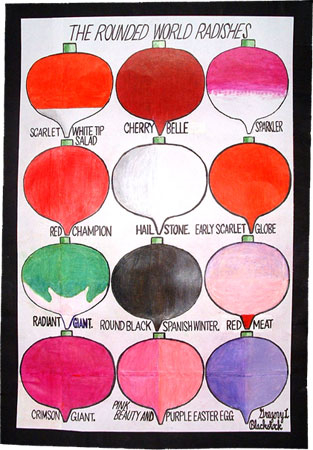
In 2001, Gregory Blackstock retired from "25 1/3" years of work as a pot washer at the Washington Athletic Club (WAC). This has given him more time to devote to his art and music interests. He has been publishing drawings since 1986, first and the WAC newsletter and recently in a book of his work Blackstock's Collections: The Drawings of an Artistic Savant.
Blackstock is an autistic savant, he speaks many languages, can recall events with an uncanny precision and is an incredible mimic. He is also very skilled with music and can be seen around Seattle playing his accordion. He first caught the attention of the Garde Rail Gallery in 2003 leading to several shows and the eventual publication of his book. Many, many more images on their site.
The subject matter for his drawings varies a great deal from state birds to state prisons, tools to WWII bombers, and mackerel to Boeing jet liners. I've mostly included the drawings of animals and birds with a few vegetables, focusing on the images from nature.
His drawings are often large, made up of smaller pieces of paper taped together. They are complete collections, laid out in precise rows. The drawings created with pencil, crayon, ink and marker. The range of scale is seen here:
Blackstock is wearing a t-shirt with his drawings as a design! (Where can I get one!)
A revealing description of his abilities and personality: "Gregory Blackstock says he speaks 12 languages and is happy to prove it, bellowing greetings in a rapid succession of diverse tongues. Not only does he have perfect pitch, he can play any instrument he picks up but prefers the accordion, because it's loud." Regina Hackett, Seattle Post-Intelligencer.

Hybrid

The Mechanics of it boggle the mind.

Wednesday, January 25, 2012

Medusae

While not exactly the same as the siphonophores, who am I to split hairs when it comes to simple and elegant design.
Pendant Lamps by Roxy Towry-Russell