Monday, July 18, 2011

Bees


The other day two beekeepers competed in China's annual bee wearing contest. Each man wore only shorts, goggles and nose plugs. The two bee enthusiasts competed by each standing on a scale and using queen bees to attract as many drones to their bodies in one hour. The queen bees were locked in small cages and tied to them and the swarming bees picked up their scent and formed living suits around the competitors.

Wang Dalin won the bee-wearing competition, by attracting 26 kilograms of bees onto his body, while his fellow beekeeper only manged to attract 22.9 kilograms of live bees. Despite their valiant efforts, the two weren’t able to break the world bee-wearing record, of 39.5 kg (350,000 bees), set by American Mark Biancaniello.

The origin of bee bearding is attributed to Peter Prokopovitch, a Russian beekeeper, in the 1830s. Although bee keepers through the centuries have encouraged masses of bees to congregate on their bodies. The practice spread to various "freak" exhibitions at American carnivals by the end of the nineteenth century.

This Vintage bee bearding photograph is from Life 1955.
It seems like a dangerous pastime, although a beekeeping friend told me that after a few years of working with bees the stings no longer hurt and she has no reaction to them. So maybe it wouldn't be that bad. Although for anyone who has even passed close to a hive and heard the sound from within I would imagine the sound would be deafening. Especially after what I assume is several hours of supporting many pounds of moving, buzzing, vibrating bees.

Perhaps a little like this clip from Mathew Barney's Cremaster 2

Wednesday, July 13, 2011

Through the hour-glass....

A tenuous Vancouver summer has arrived and it seemed high time for something a little beachy....


Never have those words been so true. And walking in the sand will never be the same after seeing these photographs.

Professor Gary Greenberg painstakingly sorts through grains of sand to find the most remarkable ones to photograph. He has also developed a complicated technique for photographing each grain from dozens of angles and combining the images with special software.

The grains are magnified 250 times to reveal fragments of crystals, spiral fragments of shells and crumbs of volcanic rock.

The images are available in Greenbergs book A Grain of Sand and on his website sandgrains.com.
Original article here.

Saturday, June 11, 2011

Treasure


Last month was very exciting at the New Zealand Wildlife Centre. Manukura, the all white kiwi, was hatched. The chick is not an albino but a rare all white hatchling. Thirteenth of fourteen kiwi chicks hatched at the Centre, Manukura is being hand reared at Pukaha Mount Bruce. The captive breeding program was designed to increase the number of kiwi chicks hatched. Only ten were hatched between 2005 and 2010, so 14 for 2011 alone is a steep increase. The Pukaha sanctuary is 940 hectares and protected by over 1000 traps. All the kiwi's hatched this year will be released when the weigh one kilogram and are able to defend themselves. Manukura may not be released, as a white kiwi may be more vulnerable to predators.


Manukura - the little white kiwi. from Mike Heydon on Vimeo.

For countless eons New Zealand's only mammal species were bats. The Maori arrived almost a thousand years ago with little impact to the birds, except perhaps the Moa. When Europeans arrived in New Zealand in the mid 1600's there was a great impact on both the Maori people but also New Zealands distinct avian species. Europeans brought with them cats, dogs and weasels and later when they settled there, goats, sheep and pigs. That latter group declined the natural habitat while the former group preyed on species that had not had such predators before. Many of New Zealand's birds are really only surviving in island sanctuaries that have been culled of mammals. Hopefully these newly hatched kiwis will give the species a foothold that it desperately needs.

Even if little Manukura is unable to be released the amount of awareness that such a special chick has raised is very important. Rangitane chief executive and Pukaha board member Jason Kerehi said tribal elders saw the white chick as a tohu, or sign, of new beginnings.

"Every now and then something extraordinary comes along to remind you of how special life is. While we're celebrating all 14 kiwi hatched this year, Manukura is a very special gift."

Monday, May 30, 2011

In Bloom


The last few posts have been a little dark. Or at least a little gross.
So here is one that will hopefully inspire some spring-time. I came across the following image on Cedars Between the Pines, the sweet tumblr site operated by my cousin Emma. She must spend a shocking amount of time online!
But it makes sense that I would find it there, as we are both from the same strange and old fashioned family with one foot stuck in Victorian England. The language of Flowers, and any secret code, was of great interest to me in childhood and still filled with mysterious intrigue today.

Many books were published on the subject, the book on the left is Flora's Lexicon by Catherine Waterman published in 1857. The book on the right is Robert Tyas' Language of Flowers published in 1869.

In its most basic form The language of Flowers, or Floriography, uses flowers to send a coded message.
Red roses mean passionate love, as they still do today.
Some less common codes are:
Scarlet Lily - High souled aspirations
Cabbage - Profit
Yellow Carnation - "You have disappointed me"
Lime Blossom - Fornication

Some of the codes seem a little diluted, yellow roses can mean: Friendship, jealousy, infidelity, or apology, a broken heart, intense emotion, dying love, extreme betrayal. It seems that it would be all to easy to send a mixed message.
There is a comprehensive list found here and another in chart form here.

The Victorians were all about propriety, or seeming propriety, and greatly into symbolism. Floriography plays into that need intensely. Sending secret messages under the watchful eyes of chaperones, parents and society would have been just the thrill that the Victorians craved.
The association with plants and Botany would also have helped bring it into the scope of the Victorians. Science was just emerging as an interest for the everyday Victorian and floriography would have been a simple and Romantic way to access that.
In 1829 Almira Phelps, a very early female botanist, wrote "the study of Botany seems peculiarly adapted to females; the objects of its investigation are beautiful and delicate; its pursuit leading to exercise in the open air is conducive to health and cheerfulness. Botany is not a sedentary study which can be acquired in the library; but the objects of the science are scattered over the surface of the earth, along the banks of the winding brooks, on the borders of precipices, the sides of mountains, and the depths of the forest."
Women were able to find more freedom in the arena of science so long as it was deemed suitable to their womanly selves. The mingling of sentiment and etiquette with the womanly symbolism of flowers would have been much more acceptable than delving into any sort of hard and tangible science.


Previous images clockwise from top left:
-Uncredited, woman in wonderfully absurd floral dress found via Floriography Jewelry, The Victorians and their florals have inspired many fussy unattractive things but I find this jewelry strangely appealing.
-Frontispiece from Flora's Interpreter and Fortuna Flora, by Mrs. Sarah Josepha Hale, 1850.
-To beauty, friendship and love (rose, ivy and myrtle), hand-colored engraving from Anna Christian Burke’s The Illustrated Language of Flowers, 1856.
-Cover from the Language of Flowers by Kate Greenaway, 1884. View the complete book here.

For further reading on the subject of Floriography and Victorian women and Botany have a look here and here.

Sunday, May 29, 2011

Black Mold


I came across this photo a few years ago while searching for information on removing mold from ones home. A reality when you live in a damp climate.

The tiny capillaries in my lungs clench when I look at this photograph, and yet there is something terrifyingly beautiful here. Not only does it look like a scene from a horror movie- the dark powers roiling in.
But the pattern is very lovely. If it were not made of toxic spores it would be quite lovely. Or is it just me?

So I felt an instant connection when I cam across this dress from Geneveive Savard

The black mold cocktail dress.

Savard's designs are beautiful, her patterns are very interesting, especially her bags.
She also writes a blog called Myrtle and Pearls.

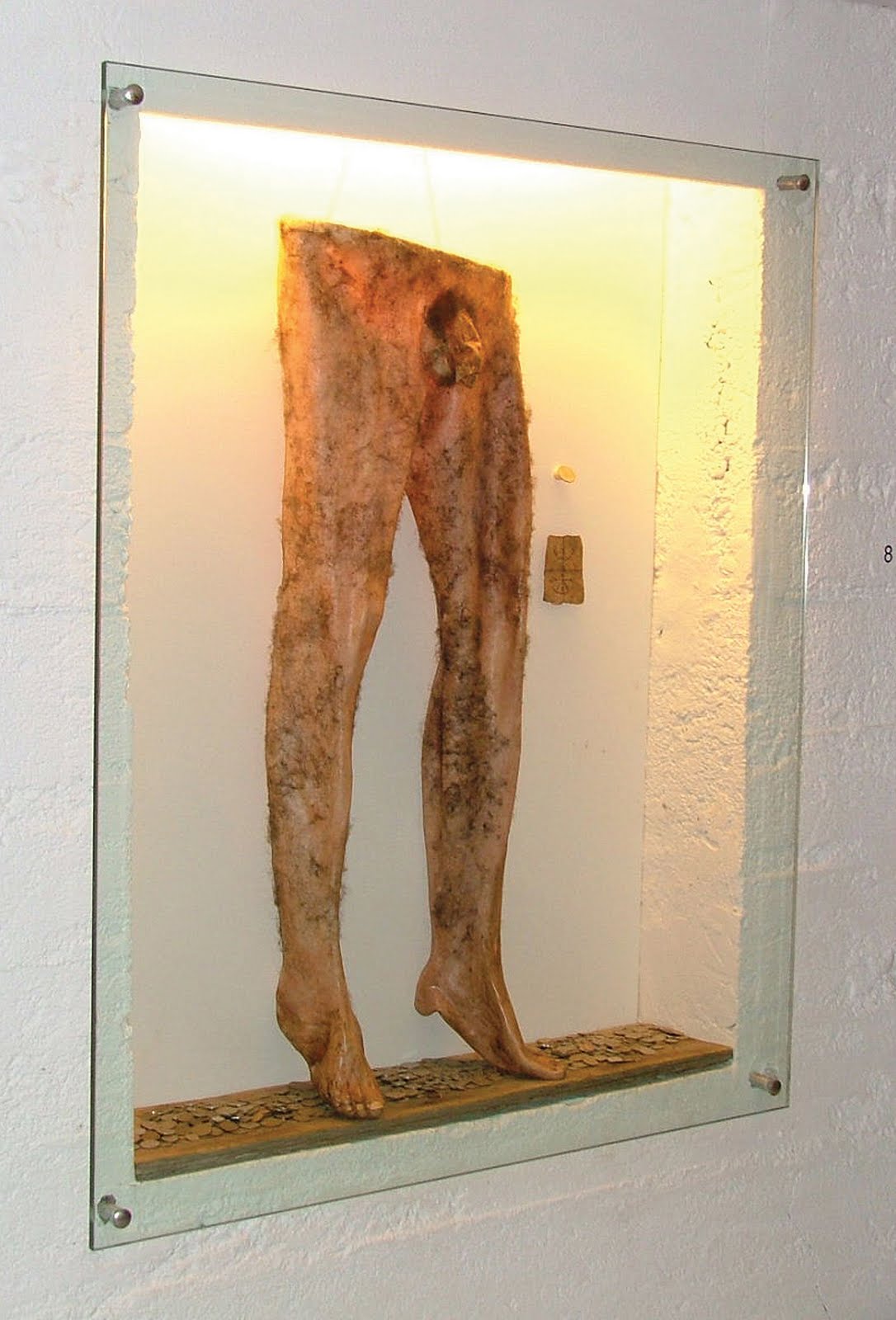
Necropants

While writing the previous post about Suzanne Lee and BioCouture I couldn't stop thinking that her clothes reminded me of something.
In her TED talk she mentions that they look a little like human skin.....

Oh wait, that's what it was.

Necropants.

This pair is in the Icelandic Museum of Sorcery and Witchcraft and are made of latex.
In medieval Iceland this macabre object was used as part of a ritual to get rich. An agreement would be made with a friend before his death. The death had to be natural and the body would have to be dug up and the skin removed from the lower half. The Necropants would have to be worn at all times next to the skin. A coin must be stolen from a poor widow and placed in the scrotum with this runic stave:
Apparently the scrotum would always be magically filled with money. For more information on the Necropants or other Viking histories have a look at this site.
Or watch this video. Necropants appear at 2:33.

Friday, May 27, 2011

Sweet Tea


These images are from the BioCouture website, and are the work of Suzanne Lee who is growing textiles from a bacterial culture. Obviously a work in process, as her TED talk explains, but visually stunning and an idea with amazing potential.


TED talks are such an amazing source of wonder and inspiration. If you have some free time at all, they are an amazing way to learn something remarkable.


The BioCouture blog is also an an amazing read. All sorts of other projects in the field of science. I look forward to reading the posts in greater depth.

Kombucha, I'm glad that it isn't just the fad drink of the moment. Quite delicious and very popular but assuredly an acquired taste.
But I work at a health food store, so my perspective is probably skewed.
Also, knowing what I do about Kombucha, I'm curious about how the garments would smell.