I haven't posted in so long because I have been determined to finish the last post from The Moon by Whale Light. Which has been taking awhile. And it is on its way. Just very slowly.
But I had to post this as I just couldn't resist!

Sunday, March 20, 2011

Monday, February 28, 2011
Moon by Whale Light: Penguins
White Lanterns
The final chapter of The Moon by Whale Light, Diane Ackerman acquaints the reader with penguins. She begins her journey in San Diego, at the Penguin Encounter, or a quarantined area near there, where King penguin chicks of various ages are being reared. As a volunteer, she is able to get very close and interact with them. They have adopted the humans as their parents and as one passes by, the chicks vie for attention and food. Penguins have no land predators, and therefore no fear of humans. This makes them easy to study, weigh and measure, and apparently the king penguin chicks are the easiest of all.

In the wild the penguins would be in rookeries of about a hundred thousand, and parents and chicks would recognize one another only by their whistle. In the wild the penguin chicks would spend all their time perched on the feet of one of their parents. The ground is too cold for them to stand for long, and the chicks huddle against a warm brood patch on the parents belly, or when they are older, huddle together. This means that the captive penguins spend all their time wanting to be fed of cuddled.
Penguins are easy to anthropomorphize, as they walk upright and live in communities. They have a comical waddle that Ackerman compares to a human toddler's.
All Penguins live in the Southern Hemisphere, on the Antarctic continent, or Sub Antarctic islands. They also live along the coasts of South America, Africa, Australia and New Zealand. One species even lives near the Equator, on the Galapagos Islands.
Penguins have changed very little in 40 million years. They have had the same basic structure for a millennium. Flightless and a little clumsy on land, they spend much of their time in the water and show true proficiency when swimming. They are streamlined, agile and fast. Scientists are only able to study them during their short courtship and breeding seasons, but the majority of their time is spent in the water.
Ackerman also journeys to the South Pole in order to make her penguin experience complete. She takes a cruise ship with over one hundred tourists and a fair number of scientists and naturalists who are hitching a ride. They travel to various islands and observe the rookeries of several different species of penguins: Magellanic, Gentoo, Chinstrap, King and Macaroni penguins. They also see a juvenile Emperor penguin but they breed too far south for the tour to see them. They are also lucky enough to see different bird species such as albatross, skua, various petrels and terns and several species of seal including the leopard seal, the greatest predator of the penguins.
Such diversity of life for a continent that is often characterized as lifeless. The largest year round species in the Antarctic is the wingless fly, measuring in at half an inch. Yet there is a great abundance of life in the summer. Fertile waters are caused by the constant sun, creating blooms of plantlife. These in turn feed krill miniscule shrimplike invertebrates) which are eaten by fish, squid and penguins themselves. Penguins catch each krill individually, needing to catch one every six seconds to get enough food. In turn this system supports other birds, seals and whales.
Ackerman describes the otherworldly beauty of Antarctica and its subtle palette. She also delves into the politics that are both protecting the continent and threatening its natural resources. At the close of one expressive passage she describes the scene from the ship.
Apricot light spills over the distant snow-tipped mountains. Chunky
wedges of peppermint-blue ice drifted past us. Behind us, the Zodiak
left a frothy white petticoat. And farther beyond, shapes arched out
of the water-penguins feeding, oblivious to what we call beauty.

Photo by John Bentham
The final chapter of The Moon by Whale Light, Diane Ackerman acquaints the reader with penguins. She begins her journey in San Diego, at the Penguin Encounter, or a quarantined area near there, where King penguin chicks of various ages are being reared. As a volunteer, she is able to get very close and interact with them. They have adopted the humans as their parents and as one passes by, the chicks vie for attention and food. Penguins have no land predators, and therefore no fear of humans. This makes them easy to study, weigh and measure, and apparently the king penguin chicks are the easiest of all.
In the wild the penguins would be in rookeries of about a hundred thousand, and parents and chicks would recognize one another only by their whistle. In the wild the penguin chicks would spend all their time perched on the feet of one of their parents. The ground is too cold for them to stand for long, and the chicks huddle against a warm brood patch on the parents belly, or when they are older, huddle together. This means that the captive penguins spend all their time wanting to be fed of cuddled.
Penguins are easy to anthropomorphize, as they walk upright and live in communities. They have a comical waddle that Ackerman compares to a human toddler's.
All Penguins live in the Southern Hemisphere, on the Antarctic continent, or Sub Antarctic islands. They also live along the coasts of South America, Africa, Australia and New Zealand. One species even lives near the Equator, on the Galapagos Islands.
Penguins have changed very little in 40 million years. They have had the same basic structure for a millennium. Flightless and a little clumsy on land, they spend much of their time in the water and show true proficiency when swimming. They are streamlined, agile and fast. Scientists are only able to study them during their short courtship and breeding seasons, but the majority of their time is spent in the water.
Ackerman also journeys to the South Pole in order to make her penguin experience complete. She takes a cruise ship with over one hundred tourists and a fair number of scientists and naturalists who are hitching a ride. They travel to various islands and observe the rookeries of several different species of penguins: Magellanic, Gentoo, Chinstrap, King and Macaroni penguins. They also see a juvenile Emperor penguin but they breed too far south for the tour to see them. They are also lucky enough to see different bird species such as albatross, skua, various petrels and terns and several species of seal including the leopard seal, the greatest predator of the penguins.
Such diversity of life for a continent that is often characterized as lifeless. The largest year round species in the Antarctic is the wingless fly, measuring in at half an inch. Yet there is a great abundance of life in the summer. Fertile waters are caused by the constant sun, creating blooms of plantlife. These in turn feed krill miniscule shrimplike invertebrates) which are eaten by fish, squid and penguins themselves. Penguins catch each krill individually, needing to catch one every six seconds to get enough food. In turn this system supports other birds, seals and whales.
Ackerman describes the otherworldly beauty of Antarctica and its subtle palette. She also delves into the politics that are both protecting the continent and threatening its natural resources. At the close of one expressive passage she describes the scene from the ship.
Apricot light spills over the distant snow-tipped mountains. Chunky
wedges of peppermint-blue ice drifted past us. Behind us, the Zodiak
left a frothy white petticoat. And farther beyond, shapes arched out
of the water-penguins feeding, oblivious to what we call beauty.

Photo by John Bentham
Wednesday, February 9, 2011
Moon by Whale Light: Whales

Photo: Flip Nicklin, National Geographic.
The following video has very interesting audio, but no visuals. I suggest listening while reading this posting.
For the third chapter of Moon by Whale Light, Diane Ackerman spends her time with whales. To meet with Roger Payne she goes first to Hawaii to listen to Humpback whales singing and then to Patagonia to study Right Whales. It was Payne who discovered Whalesong in 1967 and he has been working on theories for its purpose ever since. But little is known and whales are very difficult to study. Various theories include singing for territorial designation or for attracting a mate. It is supposed that only male Whales sing, but it is not even known how they sing. the songs are monotonous over a period of time, but change from year to year with different sounds being exchanged for one another.
Humpback Whales are a migratory species, spending the summers in cold, nutrient rich waters and migrating to warmer waters to give birth. Because of the vastness of the oceans it is very difficult for scientists to track the movement of these and other whales. After giving birth the female will not be able to feed in the tropical waters, she must wait until her calf is mature enough to travel to feeding grounds in colder climes. The calf grows very quickly, nourished by her rich milk.
For a gallery of other photos and sounds Whale Trust is an excellent resource. They also publish some beautiful books.
Ackerman meets with Roger Payne again in Patagonia, a stopping point for the endangered Right Whale on its migration to feed in the waters off Antarctica. They stop along the coast to engage in courtship and raise their young. Ackerman joins Payne and other researchers at the rustic station that he has set up there overlooking two bays that are frequented by whales.
The Right Whale is a Baleen Whale or Mysticeti, like the Humpback. They have no teeth but hundreds of closely packed, springy baleen plates that they use to filter out small prey such as krill, plankton and small schooling fish. They also have two blow holes in the top of their heads. Toothed whales (Odonoceti) such as orcas, sperm whales and dolphins only have one and echolocate to find larger prey.
 Southern Right Whale photographed by Brian Skerry.
Right Whales earned their name in a rather macabre way. They float when dead and where referred to as the 'right whale to kill' by early whalers. It is the rarest whale species, hunted almost to extinction. It is however a surface whale making it easier to study and observe. The mating of Right Whales is far more aggressive than other documented whale species. Little is known about the mating of other whales because it has not been seen. Right whale "courtship" takes place on the surface and is a riotous affair with several males to one female. The females breed every three to five years and the calves are weaned after 8 months to a year. Adolescent whales have been seen following mothers and calves and it is theorized that they may be from the previous breeding season.
Ackerman swims with a mother and calf and observes how gentle and calm they are in her presence. The young one swims very close to her but she does not touch it as it can be very dangerous to startle a whale. The calf weighs a metric ton and may not know its own strength. Casualties from Right whales have occurred when boats have been crushed accidentally by tails or fins. The following photograph by Brian Skerry for National Geographic illustrate how close one can get to these giants when careful.

For some other inspiring whale stories here are audio podcasts from Radiolab and Stuff You Missed in History.
The introduction to Radiolabs Animal Minds is a story about a rescued whale off the coast of San Francisco.
The post from Missed in History is the story of a Sperm Whale turning the tables on a whaling ship. And is available through Real-Life Moby Dick.
Sunday, January 30, 2011
Moon by Whale Light: Alligators
 Chris Jones, National Geographic.
The second part of Ackerman's adventure takes her to the Florida to follow the study of alligators. She meets with zoologist Kent Vliet at the St. Augustine Alligator Farm who is studying blood samples of alligators in captivity. The farm was started in 1893 they expanded in the 1930's and holds "a collection of the largest, oldest and fattest alligators ever". Ackerman assists them with their studies which involves measuring them and taking a blood sample. Vliet is checking their hormone levels in captivity as captive animals breed less frequently than those in the wild. Her first day in the field Ackerman climbs on the back of a large alligator to cover its eyes and comfort it. While it's jaws are taped shut, it seems like a formidable exercise, and it is Ackerman's enthusiasm for such experiences that makes her stories so engaging. She describes the alligators so beautifully and respectfully comparing their spiny backs to the Rocky Mountains and the way they feel to the 'best eraser'. It's obvious that she is fascinated by them.
 American Alligator in Atchafalaya National Wildlife Refuge. Photo courtesy of National Geographic.
The American Alligator is one of three major types of Crocodilians, there are twenty-nine different species but they can be organized most simply as Alligators and Caimans, Crocodiles and Gharials. Alligators have rounded snouts, Crocodiles triangular, pointed snouts. Alligators are apparently quite shy and mild-mannered, Crocodiles are speedier and more savage. Gharials are fish eating crocodilians with long slender snouts, frequenting the Ganges. Different species all over the world have been hunted and many populations are endangered. Luxury goods such as crocodile shoes and briefcases have reduced their numbers. They also suffer from habitat loss, sport hunting and use as novelty goods and trophies.
 Weeping Crocodile by Rob Bridges and available here.
 They also suffer from a certain amount of bad press. The associations with Alligators, Crocodiles and Reptiles in general is usually negative. Its good to see that the artists above and below feel differently. It is their cold bloodedness and reptilian brains that makes them what they are. Efficient predators that conserve energy and communicate in slow mysterious ways so different from ourselves. Being cold blooded allows them to eat infrequently and while their brains are very small they are uncomplicated and serve the alligators' needs. Crocodilians appeared about 84 million years ago and managed to compete with and outlive the dinosaurs. They are the closest living relative of birds, both evolving from a common reptilian ancestor.
While Roky Erickson probably wasn't thinking of the physiology of the alligator when writing this song to me it seems perfect.
Saturday, January 29, 2011
Moon By Whale Light.
Diane Ackerman has such an inspiring sense of adventure. I love reading her books for their beauty and insight but I also enjoy picturing her in the bizarre situations that she finds herself. In Moon by Whale Light she researches four different animals in very different environments. Bats, Alligators, Whales and Penguins. She breaks each of these chapters down into a rich mix of personal experience and scientific fact. She journeys to different places where these animals are being researched and spends time with the researchers, fleshing out their personalities and motivations for going into the fields that they did. She also makes the whole experience seem relatable. Whether she is assisting in the tagging of alligators or swimming with right whales she is curious and inspired by her adventure and it comes through so strongly in her writing.
In Praise of Bats
The first chapter of Moon by Whale Light focuses on bats. A personal favourite of mine, this may have been my initial draw to read the book. She travels to see Merlin Tuttle who has done a great deal to educate people about bats and preserve their species all over the world. One of the leading experts on bats and the founder of Bat Conservation International. Which holds a variety of useful bat information, such as how to humanely remove one from your home, as well as information on how they are impacted by wind energy and human interaction. You can even purchase the official 2011 bat calendar or your own personal bat house.
 Honduran White Bat.
Bats make up nearly one quarter of all the worlds mammals, So there is much diversity in behavior and physiology. The greatest distinction is between megabats and microbats. Megabats are the large fruit eating species such as flying foxes. They have large eyes that they use to see as opposed to echolocation and may be distantly related to the primates.
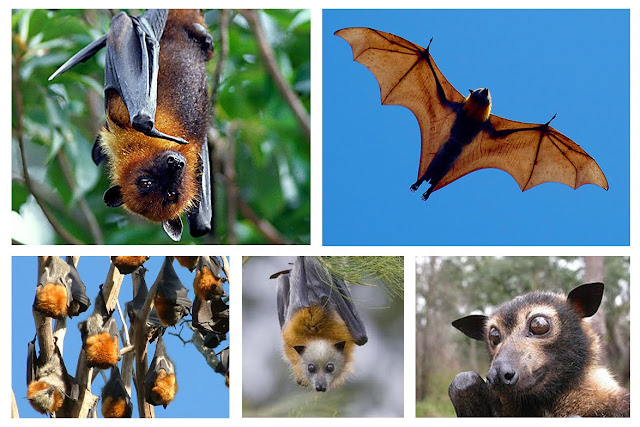 Clockwise:Marianas Flying Fox, Gray Headed Flying Fox, Gray Headed Flying Foxes, another GHFF, and a Spectacled Flying Fox

Red Flying Fox
The microbats, often referred to as the true bats, are smaller and use echolocation instead of sight. There are over 800 species making these bats far more diverse with much more visual differences.
 Clockwise: Chapin's Free-tailed Bat, Vampire Bat, Bulldog or Fisherman Bat, Greater Round Eared Bat, Silver Haired Bat, Long Tongued Bat and Big Free-tailed Bat.
All of the photos immediately previous and following are by Merlin Tuttle himself, who has done a great deal for the perception of bats simply by the way he photographs them. The common way to photograph them was to stretch them by each wingtip or clutch them tightly. Both ways show that bats terrified and trying to escape, usually with mouths open, giving the impression of being ferocious. When bats are echolocating they open their mouths, often showing their teeth. They are not threatening, only trying to understand where they are. Tuttle's photographs show a much more interesting side of bats. Each one with such different features, all to aid with echolocation or feeding. And each one looking the stoic character patiently having a portrait taken. There is a wonderful gallery of his work (a lifetime's worth) where all kinds of bats are photographed looking perfectly amiable going about their bat lives.
 Clockwise: D'Orbigny's Round Eared Bat, Yellow Shouldered Bat, Ghost-Faced Bat, Eastern Red Bat, Virginia Big Eared Bat, Hoary Bat and Cave Myotis Bat.
Changing the public perception of bats is very important as their colonies are still being disturbed and destroyed. Bats can eat several tons of insects in a year, which can be beneficial to crops, and are excellent pollinators.
 Long-nosed Bat pollinating Saguaro.
I find it hard to understand an aversion to bats as I find them delicate and endearing. I love their strange faces and the idea of a flying mammal, so efficient with its night time survival. Perhaps it is our dislocation with the night that has led to our misconceptions about bats. We rarely see them and when we do it is unexpected. Perhaps we should look a little harder for them.
In Praise of Bats
The first chapter of Moon by Whale Light focuses on bats. A personal favourite of mine, this may have been my initial draw to read the book. She travels to see Merlin Tuttle who has done a great deal to educate people about bats and preserve their species all over the world. One of the leading experts on bats and the founder of Bat Conservation International. Which holds a variety of useful bat information, such as how to humanely remove one from your home, as well as information on how they are impacted by wind energy and human interaction. You can even purchase the official 2011 bat calendar or your own personal bat house.
 Honduran White Bat.
Bats make up nearly one quarter of all the worlds mammals, So there is much diversity in behavior and physiology. The greatest distinction is between megabats and microbats. Megabats are the large fruit eating species such as flying foxes. They have large eyes that they use to see as opposed to echolocation and may be distantly related to the primates.
 Clockwise:Marianas Flying Fox, Gray Headed Flying Fox, Gray Headed Flying Foxes, another GHFF, and a Spectacled Flying Fox
Red Flying Fox
The microbats, often referred to as the true bats, are smaller and use echolocation instead of sight. There are over 800 species making these bats far more diverse with much more visual differences.
 Clockwise: Chapin's Free-tailed Bat, Vampire Bat, Bulldog or Fisherman Bat, Greater Round Eared Bat, Silver Haired Bat, Long Tongued Bat and Big Free-tailed Bat.
All of the photos immediately previous and following are by Merlin Tuttle himself, who has done a great deal for the perception of bats simply by the way he photographs them. The common way to photograph them was to stretch them by each wingtip or clutch them tightly. Both ways show that bats terrified and trying to escape, usually with mouths open, giving the impression of being ferocious. When bats are echolocating they open their mouths, often showing their teeth. They are not threatening, only trying to understand where they are. Tuttle's photographs show a much more interesting side of bats. Each one with such different features, all to aid with echolocation or feeding. And each one looking the stoic character patiently having a portrait taken. There is a wonderful gallery of his work (a lifetime's worth) where all kinds of bats are photographed looking perfectly amiable going about their bat lives.
 Clockwise: D'Orbigny's Round Eared Bat, Yellow Shouldered Bat, Ghost-Faced Bat, Eastern Red Bat, Virginia Big Eared Bat, Hoary Bat and Cave Myotis Bat.
Changing the public perception of bats is very important as their colonies are still being disturbed and destroyed. Bats can eat several tons of insects in a year, which can be beneficial to crops, and are excellent pollinators.
 Long-nosed Bat pollinating Saguaro.
I find it hard to understand an aversion to bats as I find them delicate and endearing. I love their strange faces and the idea of a flying mammal, so efficient with its night time survival. Perhaps it is our dislocation with the night that has led to our misconceptions about bats. We rarely see them and when we do it is unexpected. Perhaps we should look a little harder for them.
Monday, January 24, 2011
Monkey Faces
Monkey Portraits by Jill Greenberg
 I just bought this book as a gift, but absolutely had to take a look through it first.
The portraits are beautiful and expressive and so very human. I try very hard to steer clear of anthropomorphism, but with monkeys it seems like such a natural progression or evolution. To make them even more human the monkeys all have names and there is a list of each ones resumé in the back. I suppose that when looking for monkeys in the US that will sit still in front of the camera, it makes sense to choose monkey actors. Although I would imagine that she is a very patient photographer as her subjects have also included portraits of bears and wailing children.
 While the humanness of the monkey is appealing, I think what really draws me to them is the duality of them. Actions that look so familiar and comedic but very obviously belong to a wild animal. Sweet little faces that contain enormous teeth. Shown so well by the Golden Snub-Nosed monkey from China. Recently photographed by Cyril Ruoso for National Georgraphic
 Hard to fathom that this little creature is related to the ones below. But a healthy reminder that nature is rarely one sided.
Ruoso has had a great deal of experience photographing in the field and photographing teeth much larger those of the wee Snub-Nose.
It's obvious that we are so drawn to monkeys and apes because we see ourselves in them and vice versa, but perhaps this self reflection includes all sides of them.
 I just bought this book as a gift, but absolutely had to take a look through it first.
The portraits are beautiful and expressive and so very human. I try very hard to steer clear of anthropomorphism, but with monkeys it seems like such a natural progression or evolution.
 To make them even more human the monkeys all have names and there is a list of each ones resumé in the back. I suppose that when looking for monkeys in the US that will sit still in front of the camera, it makes sense to choose monkey actors. Although I would imagine that she is a very patient photographer as her subjects have also included portraits of bears and wailing children.
 While the humanness of the monkey is appealing, I think what really draws me to them is the duality of them. Actions that look so familiar and comedic but very obviously belong to a wild animal. Sweet little faces that contain enormous teeth. Shown so well by the Golden Snub-Nosed monkey from China. Recently photographed by Cyril Ruoso for National Georgraphic
  Hard to fathom that this little creature is related to the ones below. But a healthy reminder that nature is rarely one sided.
Ruoso has had a great deal of experience photographing in the field and photographing teeth much larger those of the wee Snub-Nose.
It's obvious that we are so drawn to monkeys and apes because we see ourselves in them and vice versa, but perhaps this self reflection includes all sides of them.
Monday, January 10, 2011
Mermaids

Just discovered the beautiful jewels of Emily Miranda so perfectly suited to adorn one of the Sirens of myth. Illustrated above by Arthur Rackham.


from top to bottom: Bent Scallop Cuff, Oyster Encrusted Cuff, Claw Encrusted Cuff, Grotto Ring, Claw Earrings and Oyster Cuff. Each piece is unique and I find the construction and level of detail awe inspiring. And they fit perfectly with my idea of mermaids as being beautiful and sinister. The only modern mermaid I feel fills this role is Effluvia from the brilliant mind of Dame Darcy.

 If you want to find the rest of this comic, it is available in the Meat Cake collection from Dame Darcy.
I will make a concession on the sinister mermaid front for this video from the Flight of the Conchords, as their mermaids dangerous on the misdemeanor level.
Subscribe to:
Posts (Atom)